
Consumer Evolution: Product Benefits Eclipse Brand Identity


Brands have shaped consumer behaviour for centuries. Early forms of branding date back to around 2700 BCE in ancient Egypt and Mesopotamia, where cattle ranchers marked livestock to show ownership. Branding evolved significantly during the Industrial Revolution (1750–1870), when mass production made it essential for companies to distinguish their products from competitors. Today, brands compete in a crowded digital marketplace where consumers encounter thousands of ads each day. Branding has become an interactive experience, with social media and online platforms enabling consumers to engage directly with brands. Brands no longer simply advertise – they connect.
While many people think of branding as simply a logo or tagline, it is the full emotional and psychological impression a business creates in consumers’ minds. Strong branding turns a generic product into a recognizable experience that people trust and return to. In an era of abundant choice, branding should be more important than ever. Yet as consumers increasingly view food as medicine, product benefits are beginning to outweigh brand identity.
The Evolution of Product Benefits
In her article Function Beats Fame: Why Big Food Brands Are Losing Their Edge, Lisa Buckingham argues that brand power is declining as consumers place greater value on product benefits than on the name printed on the package. She notes that the top 20% of brands are losing long-term share, while shoppers increasingly focus on attributes such as protein, fibre, sugar, salt, calories, and ingredients.[1]
The Global Health and Wellness Market
The global health and wellness market was valued at €892B in 2025 and is projected to grow 3% annually through 2029.[2] Findings from the Deloitte Centre for Health Solutions indicate strong consumer interest in using food to manage health, with 76% of consumers agreeing with this statement, regardless of age.[3]
The Rise of the Functional Foods and Beverage Sector
Functional foods and beverages are the fastest-growing segment of the wellness market. Designed to support well-being and immunity, they often contain ingredients such as vitamins, probiotics, and fibre. Valued at US$398B in 2025, the category is projected to grow at a CAGR of 10.65% between 2026 and 2034.[4] Globally, every 2nd food and beverage product launched in 2025 had a functional / heath claim. The top 7 benefits sought out by functional-nutritional purchasers is outlined in Chart 1 – Appendix 1.[5]
Top Functional Food and Beverage Health Benefits
- Digestive Health: Designed to support digestive and gut function.
- Market value in 2025: €12B with a 5.3% CAGR: (2025-2029).
- Consumers seek products that are high in fibre. Ie: Functional bakery.
- Energy: Boost or sustain energy levels.
- Market value in 2025: €79B with a 3.9% CAGR: (2025-2029).
- 63% of consumers wish to improve their energy levels over the next 12-months, and 77% research ways to improve their energy levels. Ie: Functional yogurts.
- Fruits can also provide a natural energy boost. Bananas and oranges are the top 2 fruits.
Consumer Insights
- 71% of consumers consume functional foods and beverages at least once a week.[6]
- 74% of global shoppers will pay a premium for functional foods and beverages that contain scientifically backed functional ingredients that solve a health or lifestyle problem.[7]
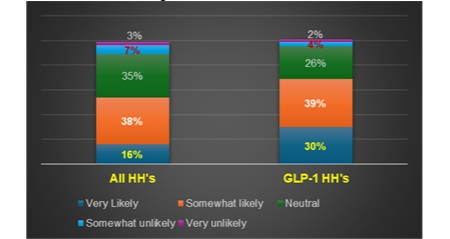
- Consumers are using AI to discover healthier product recommendations. Please refer to Chart 2-Appendix 1.
The Functional Food and Beverage Consumer
For Millennials and Generation Z, wellness has become a daily, personalized practice rather than a set of occasional activities or purchases. Close to 30% are prioritizing wellness more than they were one year ago.[8] It is estimated they spend more than other generations on wellness – 41% of total spend.[9] The areas in which Gen Z and Millennials prioritize: mental health, gut health, weight management, stress and anxiety, sleep, immune, and gut health. Gen X and Boomers seek functional foods and beverages for various health-related benefits that includes, mental awareness, heart health, gut / energy, and alertness.
The Expectation of Functional Food and Beverages
“I want the healthy added benefits without having to compromise on flavour, taste, and texture”.
Qualitative Input Consumer Focus Groups, AGRANA, May 2026
“Consumers are no longer satisfied with products that offer health benefits alone; they now expect these products to deliver pleasurable, indulgent, and even playful experiences as well”.
Mintel
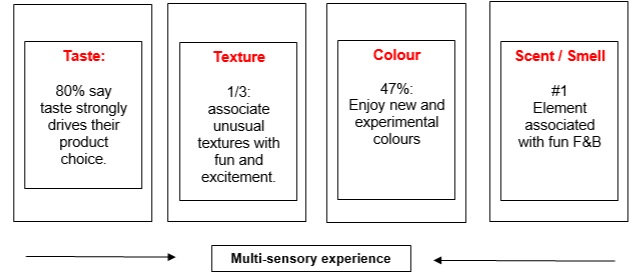
What Fun Means for Consumers.[10]
Fun foods typically deliver an emotional response; They don’t just taste nice.
Food Distribution Guy’s Final Thoughts
The term “functional food” emerged in the mid-1980s. The Japanese were the first to recognize that food could offer benefits beyond basic nutrition. In North America, the functional food and beverage sector is still in its early stages – particularly in Canada, where I feel the market remains underdeveloped. Yet growth is accelerating: the North American market is projected to expand at an 8.33% CAGR between 2026-2030.[11] This emerging sector should serve as a wake-up call for established brands.[12] In the UK and US, 37% of consumers prefer smaller brands for functional benefits, compared with 18% who prefer established brands. Poppi, a prebiotic soda brand acquired by Pepsi in May 2025 for $1.95B USD, is a prime example of this trend. I leave you with these 2 quotes:
“The food you eat can be either the safest and most powerful form of medicine, or the slowest form of poison.” – Ann Wigmore
“Functional beverages have emerged as a status symbol… we’ve traded traditional sodas and
sugary energy drinks for prebiotic sodas and high-protein coffees.” – Industry Consensus, CNBC
APPENDIX 1
Chart 1
Top 7 Benefits Sought Out by Functional-Nutritional Purchasers
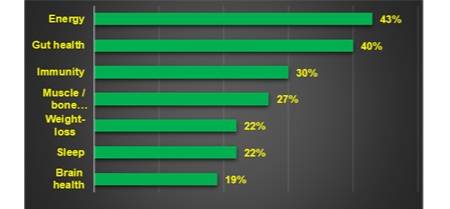
Chart 2
Likelihood of Choosing an Unfamiliar AI-Recommended Food or Beverage that Meets Health Goals.[13]
References:
- Function Beats Fame: Why Big Food Brands are Losing Their Edge, www.foodnavigator.com, June 202
- When Healthy is Not Enough: What is Missing in Functional F&B, www.foodingredientsfirst.com, 2026
- Consumers Want to Eat Their Way to Better Health, www.deloitte.com, July 2025
- Functional Food and Beverage Market Size, www.fortunebusinessinsights.com, June 2025
- The 2 Trillion Global Wellness Market Gets a Millennial and Gen Z Glow Up, www.mckinsey.com, May 2025
- When Healthy is Not Enough: What is Missing in F&B, www.foodingredientsfirst.com, 2026
- “Will Global Consumers Pay a Premium Price for Functional Food & Beverage”, AI Overview, 2026
- The 2 Trillion Global Wellness Market Gets a Millennial and Gen Z Glow Up, www.mckinsey.com, May 2025
- The 2 Trillion Wellness Revolution, www.linkedin.com, June 2025
- When Healthy is Not Enough: What is Missing in F&B, www.foodingredientsfirst.com, 2026
- North American Functional Foods and Beverages Market Size: 2026–2030, www.technavio.com
- State of Food and Beverage, www.mckinsey.com, April 2026
- Nielsen IQ, Chris Costagli, July 2026